
In the breathtaking landscape of Llangollen, Wales, there exists a unique marvel that defies the boundaries of the ordinary. As you embark on a leisurely stroll along the Llangollen canal, prepare to witness an extraordinary spectacle: boats gracefully traversing the sky. The Pontcysyllte aqueduct, an architectural masterpiece designed by Thomas Telford, serves as an awe-inspiring detour along Offa's Dyke Path.
Imagine the enchanting sight of a canal boat suspended 40 meters above the ground, accompanied by intrepid canoeists navigating the lofty waters. In this incredible setting, lifejackets become a humble accessory, as one can't help but wonder if parachutes wouldn't be more fitting for this gravity-defying journey.
If you plan to extend your visit to Llangollen and indulge in this gravity-defying spectacle a bit longer, there are numerous 4 star hotels in Wales, ensuring a luxurious and comfortable stay that complements the extraordinary experiences of your day.
Worried about choosing the best hotel? Don't be! You can find the perfect match for your requirements and mood at tophotels.com, offering a diverse collection of top-notch accommodation options across Wales. Turn your dream holiday into a memorable reality and succumb to the enthralling charm of Llangollen!
Allow yourself to revel in the knowledge that this fantastical experience can only be found in and around the Llangollen canal. Stretching an impressive 307 meters in length, the Pontcysyllte aqueduct stands proud on 18 stone arches, serving as a testament to the ingenuity of the Industrial Revolution. As a designated UNESCO World Heritage site, the aqueduct is a must-see phenomenon that showcases the remarkable achievements of humankind.
And there is a lot more. This walk has numerous permutations, plus some combinations with the Offa’s Dyke Path, but I will assume a five-mile walk, a pub lunch, then a walk back along the same route. It’s so good, you will happily do it again.
We start to the south of the small town of Chirk, where the Llangollen canal comes curving in from the east, heading for the hills. Park by the canal (there’s a railway station in Chirk too) and set off north along the towpath. You are about to experience a number of engineering marvels and the opening salvo comes immediately with a 216-metre-long aqueduct that spans the River Ceiriog and valley.
If you think canal walks are monotonous and lacking in excitement, prepare to have your perception shattered. Setting off on this particular canal walk will introduce you to a world of architectural grandeur and historical marvels.In the late 18th century, Thomas Telford made a name for himself as an esteemed architect in Shrewsbury. However, it was his remarkable accomplishment of connecting the rivers Severn, Dee, and Mersey through a canal system that propelled him into the prestigious ranks of civil engineers. Telford's masterpiece can be observed up close by strolling along the towpath - a colossal Georgian plumbing marvel in the form of an elongated cast-iron bath, providing ample width for a canal boat to be towed by a horse 21 meters above the valley.As you traverse this engineering marvel, a new wonder awaits: the Chirk tunnel. Spanning an extensive length of 420 meters, this unilluminated tunnel burrows through the heart of a hill, immersing you in a fascinating underground experience. By embarking on this canal walk, you will not only revel in the tranquility of the surrounding natural scenery, but also gain a deeper appreciation for the ingenuity and vision of Telford's architectural prowess. Immerse yourself in history as you traverse these awe-inspiring landmarks, making this excursion a truly unforgettable experience.Fact 1: The Aqueduct Inn, located in Llangollen, Wales, offers a cozy and welcoming atmosphere for visitors to relax and unwind after a day exploring the Glyn Ceiriog Valley and the remarkable Telford aqueduct.Fact 2: In addition to its historical significance, the Aqueduct Inn serves delicious traditional Welsh dishes, allowing patrons to indulge in the local cuisine while basking in the stunning views of the canal and surrounding landscapes.
If canal walks have a reputation for being low key and unadventurous, you will reconsider after this
In 1793 Thomas Telford was a respected architect in Shrewsbury, but his work in joining the rivers Severn, Dee and Mersey by canal would catapult him into the super-league of civil engineers, a realm he would dominate until the flamboyant young upstart Brunel eclipsed him.
The towpath is the best place to inspect Telford’s creation, a giant piece of Georgian plumbing consisting of an elongated cast-iron bath wide enough for a canal boat to be pulled along it by a horse 21 metres above the valley. No sooner is this finished than you enter the next marvel: the Chirk tunnel, a 420-metre unlit hole that burrows under the hill.

A walker and a boat entering the Chirk tunnel. Photograph: Kevin Rushby/the Guardian
It is not the longest canal tunnel in Britain, but it is the longest you can safely walk. Be warned, it does get very dark in the middle – Wilf, my terrier, was not at all keen – but you can always see both ends, and there is a sturdy handrail.
Two centuries after their creation, these engineering wonders are well bedded into the landscape, but when they were built, they caused massive upheaval: lime kilns, brickworks, docks and boats had to be constructed.
Telford seems to have been happy to take all the credit, but the truth was that many others were involved. The towpath curves through a second, shorter tunnel before it crosses an earlier, even more ambitious feat of engineering, Offa’s Dyke, which is signposted.
Look out for the line of trees following a low embankment that drops down to meet the canal on the far side from the towpath. We know why Telford built the canal – to transport limestone and iron ore – but the purpose of King Offa’s equally massive project remains a mystery.
Venturing onwards from Froncysyllte, a charming small bridge awaits your arrival, accompanied by a towpath on both sides as you approach the pinnacle: Pontcysyllte (pronounced Pont-cuss-uch-tay). In the early days of canal construction, aqueducts were deemed both desirable and unattainable due to concerns of water weight causing structural instability. However, in 1793, Benjamin Outram defied the odds and crafted a remarkable cast iron canal aqueduct, sparking a shift in perception.
Following in Outram's footsteps, Telford took up the challenge. At the magnificent Pontcysyllte, he ingeniously designed the 18 viaduct arches to be hollow, reducing weight without compromising strength. To further enhance durability, Telford even incorporated ox blood into the cement mixture. The outcome is a marvel of engineering, boasting both resilience and elegance. Prepare yourself for a thrilling experience, as the aqueduct towers precipitously high above the ground while maintaining a slender structure. This journey will undoubtedly reshape any preconceived notions of canal walks as mundane and unexciting.

A birds-eye perspective of the captivating Dee Valley is pictured above. Photograph credit: Shaw and Shaw/The Guardian
Upon reaching the northern extremity of the aqueduct, visitors are faced with two options. Those who are hearty walkers can opt to move forward, trekking the Offa's Dyke pathway, and traversing the breathtaking Eglwyseg cliffs. This region is a hub for botanical experts due to its distinctive tree species, the Llangollen Whitebeam, a species which remained unknown until the 1950s. On covering a distance of three miles, there's a pathway leading to the left. This way takes walkers to Castell Dinas Bran, a historical site which houses an iron age hillfort and some 13th-century ruins, and then carries them forward into Llangollen.
Should time allow, be sure to pay a visit to the historical Plas Newydd. This whimsical cottage resonates with the spirit of the Regency era, masterminded by Eleanor Butler and Sarah Ponsonby. Embedded in its history is the reputed inspiration it lent to Anne Lister, affectionately known as "Gentleman Jack". She, along with other notable figures such as Byron, Shelley and the Duke of Wellington, was among the many who visited this gothic fantasy house. After absorbing the atmosphere of Plas Newydd, make your way back to the canal's towpath and recommence your eastward journey along the canal path.
Alternatively, when you have crossed the aqueduct, follow the B5434 road down to the River Dee, where the 17th-century stone Cysylltau bridge gives a great view of the aqueduct. Continue up the road and turn right at the top for the Aqueduct Inn.
Start Aqueduct Inn or the car park below
Distance 10 miles but easily adapted to be shorter, or longer
Time 5 hours
Total ascent 30 metres
Difficulty An easy route to follow. Take a torch for the tunnels.
The pub
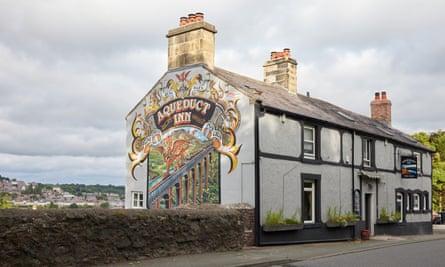
Construction of the aqueduct was, no doubt, a thirsty business and after a day’s work the builders would step up the hill to the nearest establishment. There had been an inn on the spot for a long time, but a new name, The Aqueduct, was soon adopted. Nick Edwards and partner Teresa bought the place in 2016 and have finally (after an extended pandemic pause), refurbished it, bringing in an uncluttered yet cosy atmosphere.
The pub can be spotted a long way away by the addition of a spectacular mural artwork by canalboat artist Alan Baillie on the east-facing gable end. Whether Telford himself enjoyed a pint of Three Tuns in the bar is unknown, but in 1995 Luciano Pavarotti did visit while attending the nearby Eisteddfod. On entering, he heard the Froncysyllte Choir practising in the next bar and famously joined in. It’s that sort of place: friendly and relaxed.
There’s a terrace too, overlooking the canal and aqueduct. Food always includes vegetarian options and sharing plates. The steaks are from Welsh Black cattle reared in the hills around the village.
The pub is on Facebook
Accommodation Options
Anticipate the unveiling of three inviting upstairs rooms at The Aqueduct Inn come the succeeding spring. The standout among these is the one offering a north-facing panorama of the Dee valley stretching towards the aqueduct. Enjoy the open, light-drenched ambiance within these rooms, characterized by oak beams and window sills, stone accents, and walls in a refreshing shade of citrus. Each room also boasts a modern, newly installed shower room.
A perfect stop for those traversing the Offa's Dyke path is the Llangollen Hostel. Expect rooms that exude a delightfully simplistic charm from £43 a night, an extensive selection of books and games, and a piano that adorns the lounge. A communal kitchen area allows visitors to prep their own breakfast. For more information, check out their website at llangollenhostel.co.uk.